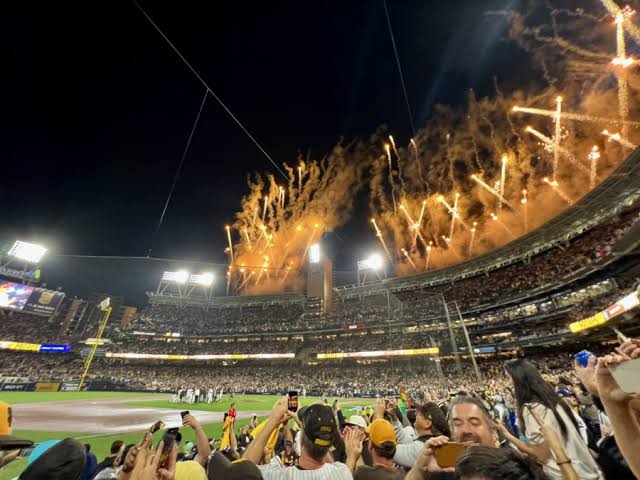
Some seasons end with a parade. Others end with a lump in your throat, a thousand unanswered what-ifs, and the uncomfortable realization that you would do it all over again in a heartbeat.
There is something uniquely cruel about loving the San Diego Padres. You learn to live with the tension between what could be and what has been, between the championship banners you dream about and the empty space where that first World Series trophy ought to be. You learn that October baseball can make a grown adult forget how to breathe, that a two-run lead can feel like a religious experience, and that the distance between immortality and heartbreak is sometimes no more than one swing of a bat. And then, year after year, you come back. You put on the brown and gold. You find your seat, your couch, your favorite barstool. You look out toward the ballpark and the Pacific beyond it, and you believe again.
The 2026 San Diego Padres gave us another reason to believe.
This was a team that finished the regular season 91–71, clinched its third consecutive postseason appearance for the first time in franchise history, and stormed into October with the kind of momentum that makes even the most skeptical baseball fan entertain dangerous thoughts about November. <escape>They won 17 of their final 20 regular-season games, swept the Chicago Cubs in the National League Wild Card Series, and arrived in the Division Series carrying the unmistakable feeling that this might finally be the year.</escape> <Cite refs={[“turn959444search0″,”turn959444search2″,”turn959444news3”]}/> Not just another respectable season. Not just another playoff appearance to file away in the franchise archives. This felt like a team that had weathered the summer, survived the uncertainty, and emerged on the other side ready to make a little history.
And for a while, it was easy to imagine the whole beautiful thing coming together.
The summer that tested our faith
Every great baseball season has its own particular character. Some are defined by dominance, some by improbable comebacks, and some by the slow accumulation of small victories that eventually become something bigger than the sum of their parts. The Padres’ 2026 season was a story of perseverance: a team that had to fight for its place in October rather than simply assume it would be there.
There was a point during the summer when even the future of the roster seemed uncertain. The possibility of a sell-off hung over the club, and the familiar machinery of baseball speculation threatened to turn a season of possibility into a conversation about what might be left for next year. <Cite refs={[“turn959444search0”]}/> But the Padres kept playing. They kept winning. They kept the door open.
That is something worth remembering about this team. Baseball is a six-month endurance test disguised as a game, a daily negotiation with failure in which even the best hitters make outs most of the time and even the best teams lose a third or more of their games. Nobody survives that grind on talent alone. There must be resilience, chemistry, stubbornness, and a willingness to keep showing up when the standings get uncomfortable and the headlines turn sour.
The Padres showed those qualities when they needed them most. Their late-season surge was not merely a statistical improvement; it was an invitation to the city to start dreaming again. Every win tightened the bond between a team and its supporters. Every series brought October a little closer. Every night at Petco Park became another opportunity to feel that familiar electricity, that particular San Diego combination of sunshine, salt air, brown-and-gold pride, and the unreasonable conviction that something wonderful might be about to happen.
And then came the Dodgers.
Of course it was the Dodgers.
There is no baseball rivalry quite like the one that turns an ordinary September game into a referendum on the entire universe. When the Padres beat Los Angeles 4–2 on September 25 to clinch their postseason berth, they did more than secure their place in the tournament. They reminded everyone that this rivalry is not a ceremonial arrangement in which one club is supposed to bow to the other. The Padres had earned their place, and they had done it against the team that has so often stood between San Diego and the top of the division. <Cite refs={[“turn959444search0”]}/>
For a city that has spent decades waiting for its baseball moment, that victory was worth savoring. The postseason was no longer a hypothetical. It was here. The Padres were going back, and the rest of baseball would have to deal with them.
October belonged to the believers
The Wild Card Series against the Chicago Cubs was exactly the kind of October statement Padres fans wanted. San Diego swept Chicago in two games, winning the opener 8–0 before finishing the job with a 4–1 victory. Michael King helped set the tone in Game 1, and the Padres’ pitching and execution carried them through the series. <Cite refs={[“turn959444search1″,”turn959444search11”]}/>
Two games. Two wins. No messing around.
The Cubs came to San Diego with their own hopes and their own reasons to believe, but the Padres were having none of it. This was a club that had fought through six months of baseball to get here, and it wasn’t interested in making its October stay a brief one. The sweep was clean, emphatic, and wonderfully satisfying. For a moment, the road ahead seemed wide open.
And waiting on that road were the Milwaukee Brewers.
The Brewers had won 103 games, secured a first-round bye, and earned home-field advantage throughout the National League postseason. They were a formidable opponent, a team built to make the most of October’s smallest margins. <Cite refs={[“turn959444news3″,”turn959444search9”]}/> If the Cubs series had been the opening statement, Milwaukee would be the examination.
The Padres would have to pass it the hard way.
Game 1 was a 3–2 Milwaukee victory. San Diego had taken an early lead on RBI hits from Luis Campusano and Jake Cronenworth, but Jackson Chourio’s two-run homer tied the game before William Contreras delivered the decisive blow with a seventh-inning solo shot. The Padres had been close, painfully close, but close is a cruel word in October. <Cite refs={[“turn959444news3”]}/>
Then came Game 2, and the kind of defeat that makes baseball feel less like a sport than a personal grudge. The Padres carried a 3–2 lead into the ninth inning, with Mason Miller attempting to secure a six-out save. Milwaukee loaded the bases, and Chourio delivered a two-run, walk-off single for a 4–3 victory. Just like that, San Diego was down two games to none in a best-of-five series. <Cite refs={[“turn959444news5”]}/>
Two games. Two losses. One season hanging by a thread.
You could be forgiven for thinking the story was over. The numbers were against San Diego, the Brewers had all the momentum, and the Padres needed to win three straight games to survive. It was the kind of predicament that turns optimism into a defensive mechanism, the kind of moment when fans start telling themselves that at least the team had made it this far.
But this is an ode, not an obituary. And the Padres were not finished.
Michael King and the beautiful madness of October
Game 3 at Petco Park was a different kind of night. The Padres were facing elimination, and the margin for error had disappeared. Jake Cronenworth broke a tie with a solo home run in the fifth inning, and San Diego held on for a 4–3 victory that kept the season alive. <Cite refs={[“turn959444news12”]}/>
Then came Michael King.
With Mason Miller unavailable after being placed on the postseason paternity list following the birth of his first child, the Padres had to find another way to finish the job. King, who had started Game 2, returned to the mound and delivered a six-out save. He threw 72 pitches in that relief appearance, allowing one hit and walking two as he helped secure the victory. <Cite refs={[“turn959444news6″,”turn959444news12”]}/>
Think about that for a second.
A starting pitcher, coming off a postseason start, taking the ball again to protect a one-run lead with the entire season balanced on the outcome. There are moments in baseball when the sport’s ordinary logic seems to fall away, when a manager looks across the field and asks someone to do something that would sound absurd if it weren’t absolutely necessary.
King answered the call.
That is the stuff of baseball legend, even when the legend doesn’t get the ending it deserves. There is something magnificent about a player willing to burn through whatever remains in the tank because the alternative is going home. No tomorrow, no saving something for later, no guarantee of another opportunity. Just six outs, a ball, a glove, and a season that still had a little life left in it.
The Padres won 4–3. Petco Park had its moment. San Diego had another game.
And suddenly, impossibly, we had a series again.
For one night, hope wasn’t a sentimental indulgence. It was a score on the board.
Brown and gold, even when it hurts
The fourth game returned the series to its familiar October cruelty. The Brewers won 3–1, taking the Division Series three games to one and ending the Padres’ season. Fernando Tatis Jr. supplied San Diego’s lone run with a solo home run, while a spectacular catch by Milwaukee’s Garrett Mitchell robbed Manny Machado of a potential game-tying homer in the eighth inning. <Cite refs={[“turn959444news7”]}/>
A few inches. A different trajectory. One ball that falls into the seats instead of a glove.
Baseball can be merciless in its economy of heartbreak. A season that required 162 regular-season games and three postseason victories to reach this point can turn on a single defensive play, a walk, a pitch that catches too much of the plate, or a hitter who finds the one gap the defense cannot close. There is no satisfactory explanation for it, no moral lesson that makes the final score feel fair.
The Padres went home. The Brewers moved on. The scoreboard told the truth, but it could not tell the whole story.
Because a season is not merely its final game. It is every game that came before it, every improbable win, every rally that brought a stadium to its feet, every evening when the city put aside its ordinary troubles and gathered around a baseball team. It is the 91 regular-season victories, the September surge, the sweep of the Cubs, and the desperate, extraordinary effort to extend the season against Milwaukee. It is also the losses, because without the possibility of losing, winning would mean almost nothing.
The Padres did not win the World Series in 2026. They did not even reach the National League Championship Series. There is no need to pretend otherwise, and there is no honor in polishing a disappointment until it looks like a triumph.
But neither should we confuse an unfinished dream with a meaningless journey.
San Diego has a baseball history full of reasons to want more. The franchise has reached the World Series twice, in 1984 and 1998, but has never won it. Every new generation inherits that longing, along with the stories of the teams that came close and the players who made the city believe. The weight of that history can make every postseason exit feel like another chapter in the same unfinished book.
Still, the book keeps getting written.
In 2026, the Padres reached the postseason for a third consecutive year, the first time in franchise history they had managed that feat. <Cite refs={[“turn959444search0″,”turn959444search1”]}/> They gave the city another October, another reason to fill Petco Park, another opportunity to imagine what might happen if everything broke right.
That matters. Not as a consolation prize, and not because participation deserves to be confused with accomplishment. It matters because sustained contention creates possibilities. It gives a franchise another chance to learn, another chance to improve, another chance to build a team capable of surviving the extraordinary demands of a championship run.
And it gives the fans something to carry into the winter.
An ode to the city that keeps showing up
To love the Padres is to understand that baseball can be both wonderfully insignificant and absurdly important. It is a game played by men in uniforms, governed by rules and statistics, and yet somehow capable of becoming a vessel for civic pride, family memories, friendships, rituals, and hope.
There are Padres fans who have followed this team since the days of Tony Gwynn, whose names and numbers remain part of the city’s baseball vocabulary. There are fans who came of age during the more recent postseason runs. There are children who have never known a San Diego summer without the possibility of October baseball, and there are older fans who have waited decades for the ultimate celebration.
They all belong to the same tribe.
They know what it means to see brown and gold moving across a television screen and immediately feel at home. They know the particular tension of a late-inning lead, when nobody wants to say anything that might disturb the delicate balance of the universe. They know how a ballpark can become louder than the world outside it, how thousands of strangers can suddenly share one heartbeat, and how a single swing can make the entire city erupt.
They also know the drive home after a loss. They know the silence, the replaying of decisions, the insistence that one different pitch or one timely hit might have changed everything. They know the ridiculousness of caring so much about something over which they have absolutely no control.
And they keep caring.
That is the beautiful, irrational bargain at the center of sports fandom. You give a team your time, your attention, your emotions, and sometimes a truly unreasonable portion of your disposable income. In return, it gives you moments. Sometimes those moments become championships. Sometimes they become memories of what almost happened. Sometimes they leave you sitting in the dark after a season-ending loss, wondering how a game you have watched thousands of times can still surprise you with its capacity to hurt.
The 2026 Padres gave us all of it.
They gave us a summer that demanded patience, a September that rewarded belief, a postseason sweep that ignited the imagination, and a Division Series that reminded us just how narrow the path to a championship really is. They gave us the exhilaration of survival and the agony of elimination. They gave us a reason to believe that the next great Padres moment might be closer than it appears.
And they gave San Diego something worth celebrating: another season in which its baseball team mattered.
Until next year, San Diego
When the last out is recorded and the clubhouse empties, baseball leaves behind a strange kind of silence. The daily rhythm disappears. The box scores stop arriving. The conversations about lineups and pitching rotations gradually give way to football, basketball, the holidays, and the ordinary business of life. Petco Park waits for another spring.
But the season doesn’t vanish. It settles into memory.
The 2026 Padres will be remembered for their 91 wins, their third straight postseason appearance, their sweep of the Cubs, and their refusal to go quietly against the Brewers. They will be remembered for Cronenworth’s timely homer, King’s astonishing relief effort, Tatis’s final postseason home run, and the many moments that made October feel possible. They will also be remembered for how close the series sometimes felt, for the leads that slipped away, and for the opportunities that will haunt the winter. <Cite refs={[“turn959444search2″,”turn959444search11″,”turn959444news7″,”turn959444news12”]}/>
We can be disappointed without being ungrateful. We can demand more from this franchise while appreciating what this team gave us. We can recognize that a 91-win season is a real achievement and still insist that the ultimate goal remains unfinished.
Those feelings are not contradictions. They are what it means to care about a team with a championship-sized dream.
So here’s to the players who wore the uniform, the coaches who made the decisions, and the fans who filled the stands and stayed up late watching from home. Here’s to every child who imitated a Tatis swing in the backyard, every family that made a game part of its summer, every group of friends that gathered around a television in the hope of witnessing something unforgettable. Here’s to the people who believed in September, who celebrated the Cubs sweep, who stood up in the ninth against Milwaukee, and who will put the brown and gold back on when the next season begins.
The World Series trophy is still out there. The wait continues. The dream remains stubbornly, gloriously unfinished.
And that is why we will be back.
Because San Diego is not a city that needs a championship to love its baseball team, even if a championship would be one hell of a way to repay that love. We have our coastline, our sunshine, our beautiful ballpark, and a team that keeps finding its way back into the October conversation. We have memories of what has been and possibilities for what might come next.
We have the Padres.
And as the final chapter of the 2026 season closes, let us raise a glass to the team that gave us another summer, another autumn, another reason to believe.
May the next season bring healthier arms, timely hits, a few more bounces in our favor, and the kind of October that ends with confetti falling over San Diego.
Until then, wear the colors proudly. Remember the good moments. Learn from the bad ones. Let yourself feel the disappointment, but don’t let it erase the joy.
The season is over.
The faith is not.
Here’s to the 2026 San Diego Padres: 91 wins, another October, and a dream that refuses to die.
San Diego, forever brown and gold. Let’s run it back.

